Skip to content
Chapter 02 — Orthodox Lineages

Five families.
One root.

Mainstream Chinese historiography counts five orthodox styles of Taijiquan. All five trace, directly or indirectly, to the Chen lineage of Chenjiagou.

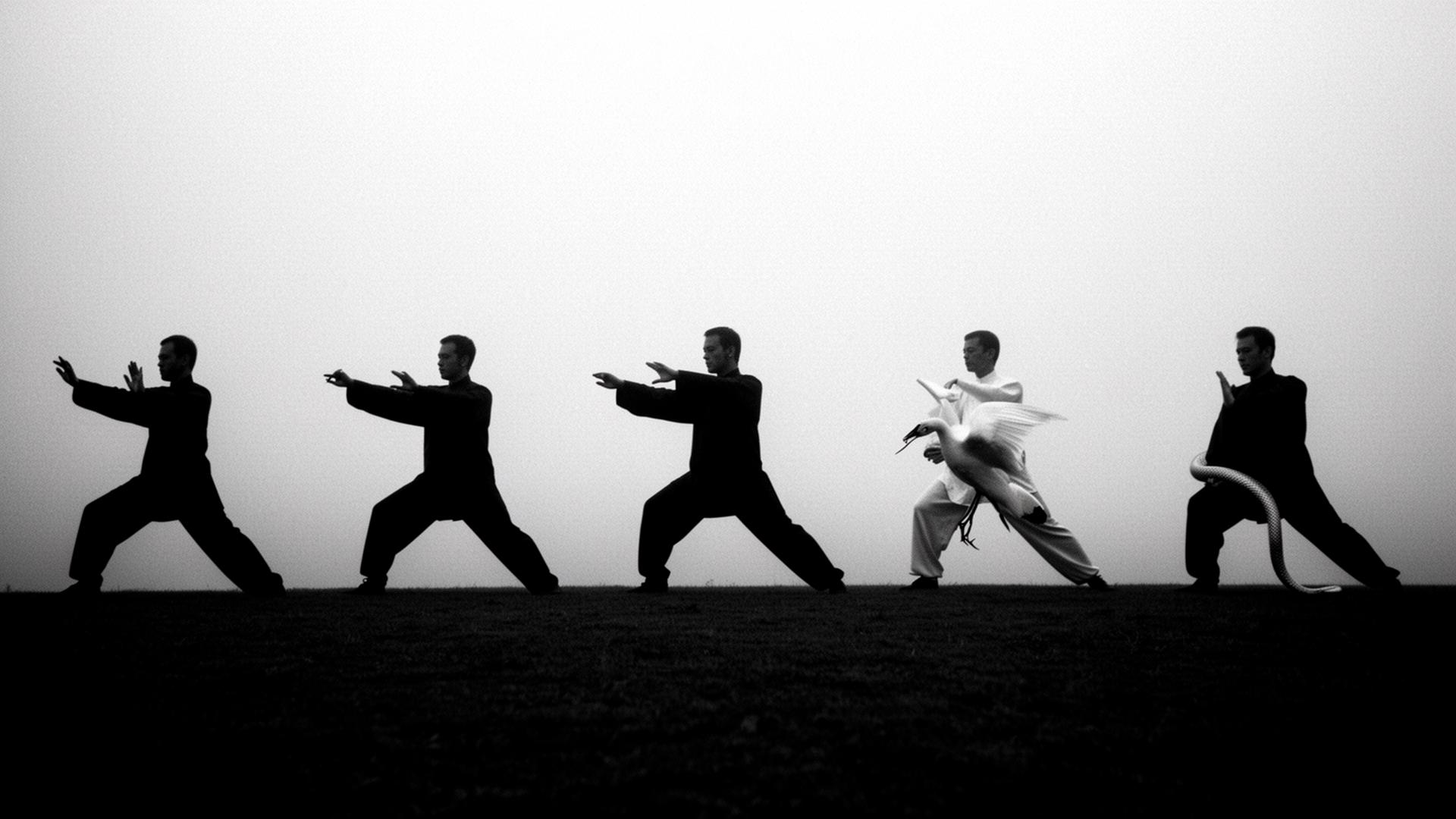
Five silhouetted practitioners side by side, each holding a different classical Taijiquan posture.
Style 01

Chen

Founder
Chen Wangting (c. 1600–1680)
Date
mid-17th century
Place
Chenjiagou, Wenxian, Henan

The progenitor style. Alternates slow continuous movement with explosive fa-jin (release of power), spiral silk-reeling (chánsijìng), low stances and pronounced stamping. The most overtly martial of the five.

Style 02

Yang

Founder
Yang Luchan (1799–1872)
Date
early–mid 19th century
Place
Yongnian → Beijing

The most widely practised style globally. Yang Chengfu (1883–1936) standardised the slow, expansive 'large frame' that today represents Tai Chi in most public parks; even tempo, gentle weight transfer, vertical posture.

Style 03

Wu (Hao)

Founder
Wu Yuxiang (1812–1880)
Date
mid-19th century
Place
Yongnian, Hebei

A small-frame, scholarly synthesis. Wu Yuxiang studied with both Yang Luchan and the Chen-style master Chen Qingping, and is associated with the canonical theoretical essays that anchor modern Tai Chi pedagogy.

Style 04

Wu

Founder
Wu Jianquan (1870–1942)
Date
late 19th – early 20th century
Place
Beijing → Shanghai → Hong Kong

Forward-leaning, compact 'middle frame'. Emphasises subtle joint work and parallel-footwork stepping, derived from the Beijing Manchu Bannerman tradition of Wu Quanyou.

Style 05

Sun

Founder
Sun Lutang (1861–1932)
Date
c. 1915–1930
Place
Hebei / Beijing

An integration of the three internal arts. Sun Lutang — already a master of Xingyiquan and Baguazhang — folded their stepping, agility and internal mechanics into Hao-style Taiji. High stances, lively footwork, follow-step movement.

One root

All five trace back to Chenjiagou.

Chen Wangting's 17th-century synthesis is the trunk. Yang Luchan carried it out of the village; Wu Yuxiang refined it into theory; Wu Jianquan softened the frame; Sun Lutang fused it with the other two internal arts. Five styles, one transmission.

陳 → 楊 → 武 → 吳 → 孫
Note on attribution

Dates given here are the conventional ones used in mainstream Chinese martial-arts historiography and lineage records published by the respective family associations. Where dates remain contested, the UNESCO 2020 dossier is treated as the canonical reference.

太極 — Wuji Tai Chi

An archive and training programme for Taijiquan, grounded in primary sources, family lineage texts, and contemporary clinical research.

Newsletter

Quarterly notes on practice, lineage, and new research.

Sources
Contact
© 2026 Wuji Tai Chi
Built on verified scholarship · UNESCO ICH 2020